 Dexscreener
Dexscreener price alerts notify you when selected price conditions are met
Dexscreener price alerts notify you when a monitored token price meets your selected condition, giving you a reason to reopen its chart. The mobile app includes unlimited alerts, allowing different levels to serve separate monitoring questions. Each setup needs the intended market, a clearly understood price unit, and notification settings suited to your device. An alert reports a price event; any trade remains a separate action with its own execution conditions.
· updated
A saved price condition and a delivered notification are separate results, so confirm the alert details and your device settings.
From Market Selection to Notification Review
Before saving a price alert, confirm the market identity, read the target’s price unit, and review device permissions. Keep the market identity available while entering the target. After saving, use a received message to confirm notification delivery. The saved entry shows the rule you requested. When a message arrives, match it to that entry before assessing the market again.
| Monitoring Stage | Condition or Observable Result |
|---|---|
| Identify the market | The network, asset, and selected pair match the chart you intend to monitor. |
| Read the price unit | The target uses the denomination shown in the alert field. |
| Choose the price condition | The target and comparison express the movement you want to review. |
| Allow notification presentation | Device permissions and presentation settings permit the intended interruption. |
| Save and inspect the alert | The saved entry matches the intended market and price condition. |
| Review the received message | A visible notification establishes delivery, without reserving a trade price. |
| Reopen the market | Current price and recent trades provide the context for any further action. |
The notification’s arrival confirms delivery, even if the price has already moved. The current chart answers where the market stands now. Any executable trade quote answers a separate question about the amount and direction you intend to trade.
Threshold Direction and Review Purpose
A price threshold marks a level worth revisiting, and its comparison determines which side of that level matters for your monitoring task. An upper boundary concerns prices moving higher; a lower boundary concerns prices moving lower. Read the comparison shown in the alert settings together with the target, because the number alone does not express the whole condition.
Returning to inspect a previous high asks a different question from reviewing a downward move toward an earlier trading range. Neither observation establishes what the price will do next. The alert identifies a condition worth examining, leaving its significance to the market context.
Closely spaced levels can draw attention to substantially the same movement. Wider spacing leaves more movement between review points. Choose spacing around distinct questions rather than filling every nearby price with another notification.
A level drawn on a chart is a visual reference. Its presence alone does not establish a saved notification rule.
Market Identity and Price Denomination
The monitored market and the target’s unit jointly define what a price condition means, especially when similar token labels appear across several trading pairs.
Asset and Pair Identity
A token name or ticker can appear beside different addresses. The network and token address identify the asset, while the pair identifies a particular market. Dexscreener market records distinguish base and quote assets alongside the pair address. An alert setup should retain the market relevant to your question; a familiar symbol alone leaves that identity unresolved.
The Unit Beside the Target
A dollar-denominated token price and a price expressed through the quote asset describe different units. Use the denomination in the alert field, even when another chart view displays a different measure. Preserve significant digits when a token price contains several leading zeros. Rounding a target changes the comparison you intended, and visual similarity cannot repair a mismatch between units.
Watchlists, Alerts, and Custom Monitoring
A watchlist keeps selected markets available for repeat viewing, while a price alert adds a condition intended to call attention to a price event. Check the saved market and notification rule separately.
Custom monitoring suits a question requiring logic beyond a single price condition. Dexscreener’s pair data includes prices, trading activity, and liquidity fields. Software can evaluate its own rules from those readings, subject to available data and the API’s request limits. The application’s scheduling, notification channel, and error handling remain responsibilities of that separate implementation.
How Many Price Alerts Can the Mobile App Hold?
Dexscreener’s mobile app includes unlimited price alerts. That capacity allows separate monitoring conditions without treating a small fixed alert quota as the planning constraint. It does not determine delivery speed, repetition behavior, or notification sounds. Keep each rule attached to a distinct review purpose. A larger collection becomes less useful when several messages require essentially the same chart inspection.
Device Permissions and Notification Visibility
Your phone’s notification settings control whether an alert appears and how it interrupts you. Check them separately from the saved price condition.
Permission to Display Messages
The app’s notification permission controls whether the device allows its messages to appear. Android supports app-level notification controls and, where an app provides categories, category-level controls. iOS also allows notifications to be enabled or disabled for each app. Permission to display a message does not require the phone to play a sound.
Presentation After Permission
Sound and Focus
On supported Android devices, silent notifications remain visible in the notification shade without making a sound or vibrating. On iPhone, Focus settings can silence selected app notifications, and a scheduled summary can collect eligible notifications for later presentation.
Lock-Screen Previews
Any token or condition shown in a notification preview can become visible to someone viewing your locked phone. iOS and Android offer controls over lock-screen presentation. Hiding content protects that visible detail, while retaining the ability to review it after unlocking.
Why Did the Chart Reach My Level Without a Notification?
A missing notification can reflect a different saved condition, device presentation settings, or a delivery problem; a chart crossing alone cannot identify which cause applies.
Configuration deserves attention when the chart and alert refer to different markets, units, or comparisons. A rounded chart label can also appear to match a target without showing the full value. Compare the saved condition with the full price in the same denomination. Review a previously triggered rule’s status before expecting it to send another notification.
Presentation deserves attention when the message exists in the notification center without a sound or banner. That observation separates unnoticed delivery from an absent message. Device menus differ, and a setting allowing messages can coexist with another setting reducing their interruptions.
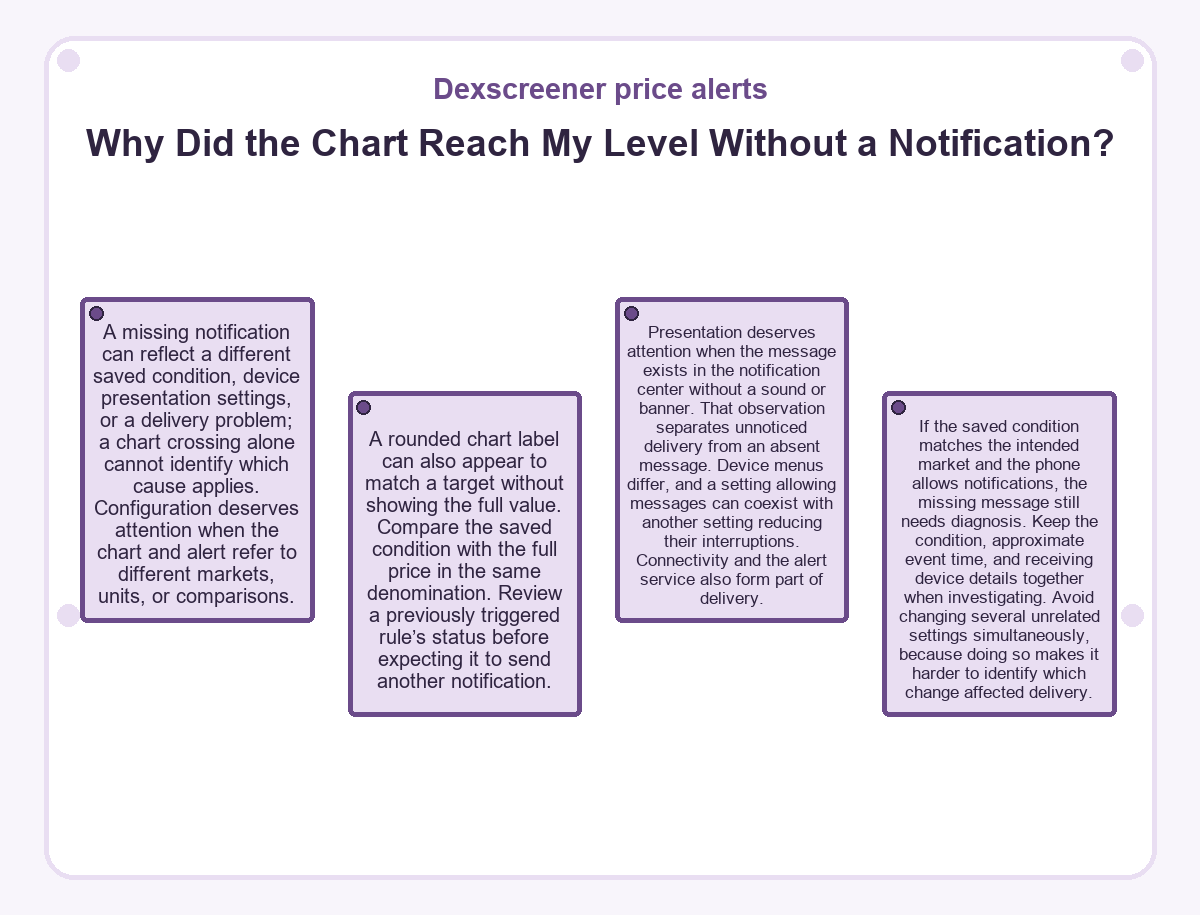
Connectivity and the alert service also form part of delivery. If the saved condition matches the intended market and the phone allows notifications, the missing message still needs diagnosis. Keep the condition, approximate event time, and receiving device details together when investigating. Avoid changing several unrelated settings simultaneously, because doing so makes it harder to identify which change affected delivery.
Data Updates and Delivery Timing
A market event, its appearance in analytics, and a notification reaching your phone describe different moments, so an arrival time cannot establish the original event time.
Dexscreener processes blockchain activity through its own indexer to produce market data. Price monitoring uses the data the service observes; message delivery and phone presentation add separate dependencies. A brief move can end before you read the message. Neither a fast chart refresh nor an unlimited alert allowance specifies a fixed end-to-end delivery deadline.
The time you receive a message and the time you inspect the chart answer different timing questions. Read any timestamp in the notification according to its label, rather than assuming it names your device’s arrival time. This distinction matters when comparing a notification with later prices or investigating an apparent delay.
Does a Price Alert Execute a Trade at the Target?
A price alert sends a notification; it does not submit a trade or reserve the target price for a later transaction.
A trade requires its own amount, direction, and executable terms. The chart price describes a market reading, while a swap quote estimates output for specific inputs. Liquidity and price impact can produce a different effective execution price. Fees and price changes before execution can affect the eventual result as well. An alert target supplies none of those transaction inputs by itself.
Monitoring a price level and enforcing an execution condition serve different purposes. A notification fits a return-to-chart task. An order or transaction rule needs the execution system responsible for accepting and completing it. Receiving the alert provides no evidence such a system has placed or filled an order.
Liquidity and Trading Activity After a Trigger
Liquidity and recent trading activity help explain the significance of a triggered price condition, because the notification identifies a level without explaining the move’s cause.
Recent trades show whether the movement accompanies continuing activity or an isolated print. Liquidity provides context for how strongly a trade amount can affect a pool’s price. They do not turn a price notification into a liquidity-change detector or establish the output a particular swap will receive.
Keeping Alerts Relevant as Markets Change
A saved threshold retains its useful meaning only while the monitored market, denomination, and reason for returning remain relevant to the question you intended to review.
Trading activity can shift to another pool, and a different quote asset changes the meaning of a price expressed through that asset. Review the market associated with an existing alert when either changes. A target copied from an earlier market can keep its digits while losing the relationship you meant to monitor.
Retire conditions whose review purpose has ended, and reconsider closely overlapping levels as your monitoring needs change. Reassess the target if the market you intend to follow changes.
Dexscreener price alerts: what people ask
Can I Treat a Price Alert as Confirmation of a Candle Close?
A price-level condition does not by itself require a candle to close. A market can reach a level while its candle is still developing. Candle-close confirmation must form part of the condition being evaluated; the chart interval alone does not establish that requirement for the saved alert.
Is a market-cap Amount Interchangeable With a token-price Target?
A market-cap amount and a token-price target use different units. Market capitalization relates a token’s unit price to the supply used for valuation. A price field concerns the value per token, so a market-cap number entered there describes a different condition. Read the metric and unit beside the saved target.
Does Receiving a Price Alert Require Sharing Wallet Recovery Words?
Wallet recovery words should never be shared for a price-notification setup. Those words control access to a wallet and are unrelated to permission for displaying app messages. Account access, notification permission, and wallet secrets serve different purposes. A request for recovery words creates a wallet-access risk, regardless of its claimed connection to alerts.
Where Can I Find an Alert Notification I Dismissed?
On supported Android devices, notification history can show recently dismissed messages when the feature is available and was enabled beforehand. Device support and settings vary. On iPhone, check Notification Center for older notifications you have not cleared. A saved alert records its configured condition, which differs from a retained delivery record; its presence alone cannot reconstruct the text or arrival time of a dismissed notification.
How Does a percentage-change Reading Differ From an Absolute Price Target?
A percentage-change reading measures movement relative to a starting price, while an absolute target specifies a price level. The percentage needs a comparison basis and time window. A chart displaying a percentage does not establish the saved alert uses that condition. Interpret the rule recorded in the alert rather than substituting a different chart metric.