 Dexscreener
Dexscreener liquidity is a measure of pool asset value used to assess swap depth
Dexscreener liquidity is the reported dollar value of assets in a selected trading pool. Whether that pool is deep enough depends on the swap amount, direction, and liquidity available along its price path. A trade quote shows expected output and price impact for those inputs. The displayed total alone cannot establish how much you can sell near the quoted market price. Concentrated positions can leave capital outside the price range a trade initially uses. Read pool value alongside reserve composition, withdrawal rights, and the proposed route. Those distinctions explain why similar totals can produce different execution costs.
· updated
Is the Pool Deep Enough for My Swap?
A pool meets a swap’s depth requirement when its quote offers acceptable output for the intended amount, direction, and applicable execution costs. The assessment starts with the token address, network, and specific pool, since a ticker can identify unrelated assets. Different pool designs make the dollar total an incomplete measure of execution capacity.
| Execution Option | Depth Constraint |
|---|---|
| Single full-range constant-product pool | Reserves and trade size determine price movement along the pool’s curve. |
| Single concentrated-liquidity pool | Positions active along the swap’s price path supply usable depth. |
| Multi-pool route, where supported | Every included pool constrains execution; additional hops can add fees and network costs. |
| The chosen route’s quote estimates output for the specified trade; pool value alone cannot establish that output. | |
Compare a direct-pool quote with a routed quote, where the interface supports both, keeping the network, tokens, and input amount unchanged. Judge both by expected output and execution costs on the same valuation basis. Select an option meeting your output requirement, then refresh its quote without changing those inputs. An unchanged pool state can support the same assessment. If a price move makes a concentrated position inactive, the refreshed quote may show insufficient output. The new quote indicates whether the proposed trade still meets your requirement.
Dollar Value and Output Reserves
Dollar-denominated liquidity summarizes pool assets, while the output token’s reserve constrains how much that pool can deliver through its own swap mechanism.
Dollar Denomination
A dollar total expresses the estimated value of tokens in the pool. It does not mean the pool holds that amount in cash. The quote asset can itself change value, so its dollar contribution can move without a liquidity deposit. Reported base-token and quote-token balances count different assets. Their raw quantities cannot be added into a meaningful total without converting them to a shared unit. API snapshots can preserve those separate quantities for repeat observations.
Output-Side Reserves
Selling the tracked token removes the other asset from the pool through a swap. The displayed pool value includes both sides, so a seller cannot treat the entire total as immediately redeemable proceeds. A seller in a constant-product pool cannot receive the full output reserve at the starting marginal price. The pool’s pricing rule determines how much input a sale needs and how much output remains available as its size increases.
Price Impact Along the Reserve Curve
A constant-product pool prices swaps from its token reserves, so the relevant depth follows the trade’s direction and size at the time of execution. Swaps change the ratio between the input and output reserves. Price impact increases with trade size relative to reserves in a constant-product pool, with other inputs held fixed. The average execution price therefore moves away from the starting price as a trade grows. Fees affect the calculation as well. Multiplying a displayed marginal token price by an entire holding can overstate realizable sale proceeds.
A liquidity-to-trade-size ratio can screen pools within a comparable design. It cannot reconstruct a quote for markets with different fee rules or liquidity distributions. No single dollar liquidity cutoff answers the depth question for every trade amount.
Concentrated Ranges and Active Depth
Concentrated pools depend on liquidity within the price ranges a swap traverses, so aggregate asset value cannot describe every trade’s execution depth.
Liquidity at the Current Price
Liquidity providers can allocate positions to chosen price intervals. Capital inside the current interval supplies trading depth there. A concentrated-liquidity position stops contributing active liquidity when the pool price leaves its selected range. Its assets can remain in the position while its contribution to current trading falls away. For the same token pair, a pool with less total capital can still provide deeper execution if more liquidity concentrates near the trade’s price.
Depth Beyond a Range Boundary
A larger swap can pass through several intervals with different available liquidity. Crossing a boundary can change the price impact on the remaining amount, even when the headline liquidity figure looks substantial. Depth therefore has a distribution across prices. The concentration serving a small trade near the starting price does not establish capacity for a large trade moving beyond that interval.
Volume and Token Valuation
Trading volume measures activity over a period, while liquidity describes pool assets at an observation time. Repeated swaps can generate substantial volume using the same reserves. Market capitalization and fully diluted valuation estimate token-supply values, rather than funds available to complete a sale. A high volume-to-liquidity ratio can indicate rapid turnover, but it does not prove organic demand or establish durable sell depth.
Changing Liquidity and Pool Composition
Liquidity changes can reflect token-price movements, trades, deposits, or withdrawals, so a change in the dollar total needs its underlying balances for interpretation.
A fall in a reserve asset’s dollar price reduces that asset’s valuation even if its token balance stays constant. A rise can increase the total without new capital entering. Comparing token quantities separates this valuation effect from a change in asset amounts.
Swaps change reserve composition: the pool receives the input asset and transfers the output asset. A heavier balance of the tracked token can coexist with less quote-asset capacity for subsequent sales. Total value can obscure this directional change.
Deposits and withdrawals change the capital allocated to the pool. On-chain activity distinguishes those operations from an ordinary swap. A withdrawal by a large provider can reduce depth abruptly. In a concentrated pool, changes to position ranges can also alter available depth near the market price.
Repeated observations need the same pool, asset units, and a recorded observation time. A saved reading describes that state; it cannot reserve liquidity for a later transaction.
Withdrawal Rights and Liquidity Locks
Withdrawal rights belong to the pool’s liquidity positions; a valid lock restricts removal through the specific shares or position the locker holds. Liquidity provider (LP) tokens represent proportional claims in pools using that accounting model. Concentrated pools can track each ranged position separately. Holding the purchased token does not automatically confer the right to withdraw pool reserves. Lock coverage therefore concerns the actual LP shares or positions associated with the selected pool.
A time lock applies to the quantity deposited and the configured expiry. An unlocked portion remains subject to its owner’s withdrawal rights. The locker contract determines the exact restriction and any permitted exceptions. Expiry permits withdrawal; it does not establish that withdrawal has happened. A locked concentrated position can also become inactive when price moves outside its range. The right to remove capital and its usefulness for trading remain separate properties.
Fees Behind the Swap Output
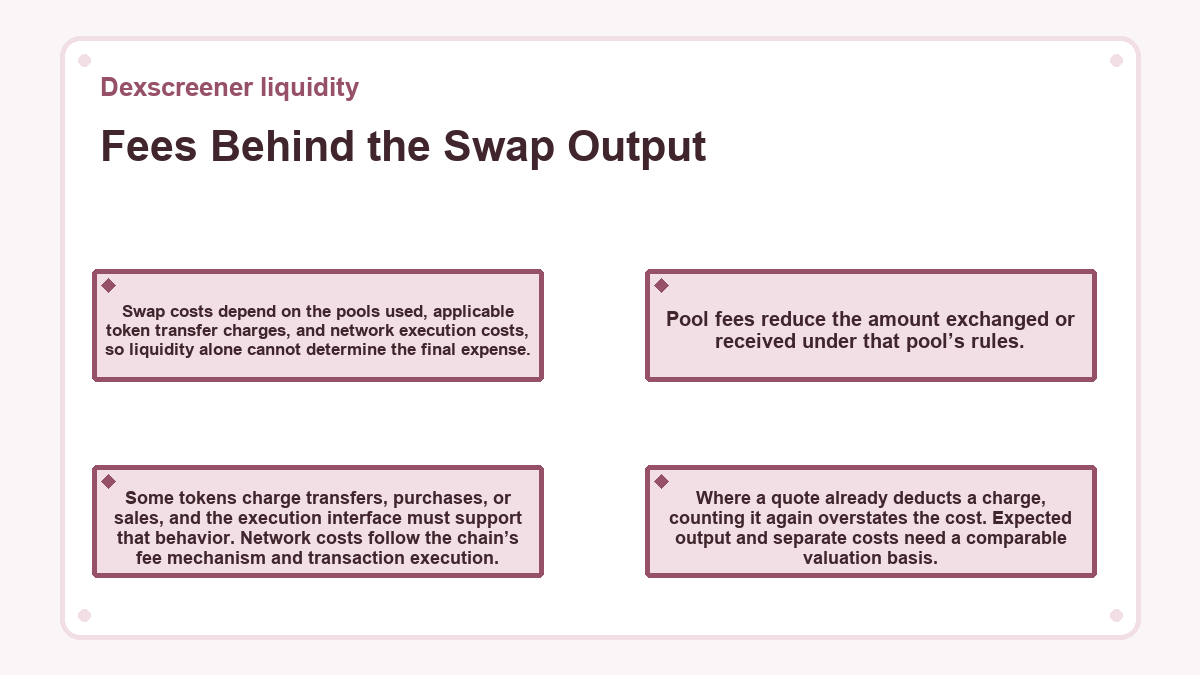
Swap costs depend on the pools used, applicable token transfer charges, and network execution costs, so liquidity alone cannot determine the final expense. Pool fees reduce the amount exchanged or received under that pool’s rules. Some tokens charge transfers, purchases, or sales, and the execution interface must support that behavior. Network costs follow the chain’s fee mechanism and transaction execution. Where a quote already deducts a charge, counting it again overstates the cost. Expected output and separate costs need a comparable valuation basis.
Slippage Limits and Token Sellability
Slippage settings control permitted changes between a quote and execution; they do not increase the liquidity available for the intended swap. Price impact already describes the trade’s effect on the pool. For an exact-input swap whose interface enforces minimum output, execution reverts if it cannot deliver that minimum. Increasing permitted slippage can allow a worse fill within the configured bound. A token’s transfer restrictions can also prevent a sale even when the pool holds reserves.
Transfer blocklists, restrictive permissions, and variable sell charges affect the token itself. LP locking does not remove those controls. A successful purchase demonstrates only the completed buy; it does not establish that the same holder can later sell through the reverse route.
Missing Readings and Unsupported Depth Estimates
Missing liquidity data leaves the pool’s reported value unresolved; it should not become a zero balance or a confident capacity estimate in a saved observation. The public pair data allows a liquidity object or its dollar value to be absent. Field availability differs from the existence of an underlying pool. A missing number cannot establish that reserves have disappeared. Missing valuation also prevents a trustworthy ratio using that denominator.
A price chart describes trading prices, while a proposed sale depends on the pool state and executable quote at that time. A stale chart value cannot reserve a particular amount of output. Without a route-specific output estimate, the reported value alone cannot establish how much that sale would receive.
Still have questions?
-
Why Does Dexscreener Show a Different Liquidity Total From Another Dashboard?
- Liquidity totals can differ when dashboards value different sets of pools or use different observation states. A token-wide total may combine several markets, while a pair reading concerns one pool. Valuation methods and reporting units can also differ. Matching pool identifiers, asset denominations, and observation times helps distinguish a reporting discrepancy from an actual change in reserves.
-
Can Adding Liquidity Change the pool’s Displayed Token Price?
- A proportional deposit into a constant-product pool increases reserves while preserving their ratio. That increases trading capacity without changing the reserve-based marginal price. An imbalanced deposit can shift the ratio and create an arbitrage opportunity. Subsequent swaps can also move the price. A rise in displayed liquidity therefore does not establish that the token’s price rose.
-
Does Locked Liquidity Prevent Swaps From Using the Quote Asset?
- Locked LP rights still allow ordinary swaps to move reserve assets into and out of the pool. The lock restricts withdrawal through the affected liquidity position. A sale can consume quote reserves under the pool’s trading rules without unlocking that position. The quoted asset balance therefore remains dynamic, even while the lock continues to apply.
-
Is Splitting a Swap Into Smaller Transactions Always Cheaper?
- Splitting a swap does not automatically reduce price impact or total cost. Successive trades in a constant-product pool consume the reserves remaining after previous trades. A smaller piece does not reset the pool to its earlier price. Separate transactions can add network costs. Fee rules, intervening activity, and the chosen routes determine whether splitting offers any advantage.
-
Does Burning Token Supply Also Lock Liquidity?
- Burning units of the traded token does not by itself restrict withdrawal rights over its pool. Token supply and LP ownership track different objects. A claim about locked liquidity must concern the relevant LP tokens or position, including the portion affected. Supply reduction may change valuation calculations, yet the pool’s ability to lose capital still follows its withdrawal rules.